Tuesday, March 14, 2006

Thrums

There's always warp waste in weaving. The only way to use nearly 100% is to use a dummy warp for tieing on to the warping beam. In September, I wove a shawl using a painted warp and solid-color rayon for weft. It came out beautiful largely in part to the painted warp. So when I had to cut off the ends of the beautiful painted warp, I simply had to save them.

Today after seeing an innovative idea of rug weaving, I tied them together end to end, wound it on a bobbin, and started weaving.

Weaving made from thrums, fabric strips, and rayon yarn

I've used three components in this fabric: the thrums, medium brown rayon yarn, and half-inch strips of fabric. Each component gets a few shuttle passes and then I move to the next one.

What will I do with the fabric? I don't know. It hasn't told me yet.

Wednesday, March 01, 2006

Felted Soap

You couldn't ask for a more simple, enjoyable, and fun project! And I'm not just talking about something for the kids.

To use these fuzzy creations, you simply get it wet under running water and rub the fiber to lather up the soap. When you're finished, wipe off the excess soap suds and let it sit to dry.

Felted soaps are a gardener's best friend. Their fuzzy texture with its built-in soap dispenser makes cleaning fingernails a breeze! In fact, these soaps are better than a loofah.

So how does one make felted soap? Read on!

Step 1
Using a bar of soap, you're going to wrap it in fiber. I've used roving made from alpaca neck and legs that I dyed green (and in later photos it "magically" turns purple :-) but you can use any carded clean fiber. I wouldn't use uncarded fiber because it tends to create a lumpy fiber covering.
Step 1: wrap soap with fiber

Step 2
Using a gentle stream of water, wet the fiber and soap. As you are doing this, scrunch the entire thing to work up a soapy lather. An alternative is to add some soap foam from one of those hand soap dispensers that put out foam soap. This will get things started faster. Be careful not to shift the fiber in a way that creates holes. I've found the fiber felts pretty quickly so be sure to cover any bare spots right away. If you do end up with bare spots, you can try adding some more dry fiber. Sometimes this works, and sometimes this doesn't. It seems to depend on the type of fiber used. Step 2: wet and scrunch

Step 3
Felt. To wet felt (and not all fibers will felt - be sure to start with a feltable fiber like alpaca), fibers must be exposed to soap and agitation. Another component often found in wet felting is extreme temperature changes. Thankfully, we don't need that component in this process. So once you have a soapy lather, rub the bar of soap along its edges. The more you agitate the fiber, the more it will felt making a strong covering for the bar of soap.
Step 3: felt


Step 4
Rinse off the excess soap lather.

Step 4: rinse


And you're done! Let it sit out to dry.

Done!  Felted Soap

Tuesday, January 10, 2006

Finished Projects


In an effort to start the new year off right, I've finished two projects I started last year. The first are the felted slippers I mentioned in a previous post. For the felting process, I washed them in our washing machine with a load of clothes using hot water. Because we have a front loading washing machine, things don't usually felt well so I took them out and hand felted them some more in the sink. Then they were popped into the dryer for the final step. I'm quite pleased with the felting and fit results, although admit they'd work better on someone's feet who lives in a fully carpetted home. I find they're a bit too slippery for our linoleum and wood floors. These were made using handspun Lincoln wool.


green silk with handwoven jacket My second completed project is one I'm quite proud of. It is a dressy jacket made using dupioni silk and my hand-spun, handwoven yardage. The story of the woven yardage: I bought some black alpaca roving while at our very first alpaca show in Southern California around Fall 2003. We weren't showing - we were just interested in alpacas. I took home the roving and spun it but wanting to make it go as far as possible, I plied it with an Ashland Bay wool roving in fall colors. Beautiful yarn! In April 2004, I entered that yarn into a fiber arts competition at the Monterey Pronk, an alpaca show in Monterey California. It won a blue ribbon! The yarn then sat in my stash for a while as I tried to figure out what I wanted to do with it. Every spinner out there knows what I'm talking about - we have many yarns that sit until they "call to us". Well this one spoke to me when I had a black cotton yarn I had put on the loom to "play" with. That warp's purpose was specifically so I could experiment with different treadling and different tie-ups. But after I was "played" out, I found I had lots of warp left over. In a simple twill, I wove the 48" of fabric.

handwoven alpaca-wool over cottonBack to "let it sit until it calls to me". In September 2005, I pulled out my pattern stash. I wanted to use the fabric to make a vest but didn't find any patterns I liked. Instead this dress jacket called to me. I made a "muslin" using the pattern pieces, adjusted it to fit me, cut the pieces apart to accomodate the handwoven fabric width and made my jacket. It helps that I've got a lot of pattern drafting experience (see the link for Kings and Sages Apparel, my line of boy's clothing) but it really was quite easy. My next project is a black corduory winter (well, California winter) jacket using some of my other handwoven stash.

Close-up of woven fabric: handwoven fabric of alpaca and wool w/cotton warp

Wednesday, January 04, 2006

More socks - this time from alpaca

Handmade Christmas presents are fun to make and give. Part of the fun is the challenge of making the gift without the recipient knowing! I made these socks for dh. Actually, the gift he opened Christmas day were the socks on the needles 75% done. It took a lot longer to knit his socks than it did to do mine because of the secrecy. Once I could knit them in the open, they were quickly finished.


I used the same pattern as before using the large size this time. I actually knit both socks in tandem. I wound the yarn into a center pull ball and worked one sock from each end. When I ran out of yarn, I switched to plain white and finished them up. The colorations aren't an exact match because it was hand dyed roving. I handspun the yarn after dyeing it as well as some of the undyed white. The roving is alpaca neck and leg fiber. It's not something I'd want to wear on *my* neck, but it's absolutely perfect for socks! The durability is supposed to be incredible. Ask dh in a few years what he thinks. His initial opinion is positive with a dash of "could you make the leg longer next time?"

I have another alpaca neck/leg roving project to post about but as that's a present for someone, I have to wait until they open it lest it spoil the surprise!

Wednesday, December 14, 2005

Socks, the first success


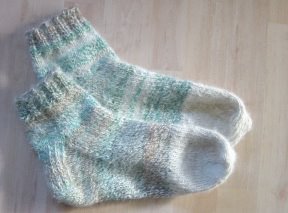
Last year I tried knitting socks. Half way through the first one I knew something was wrong. It was big enough to fit King Kong. Oops. So I put it aside in the UFO basket. A few weeks ago I picked up the same pattern and tried again. Swatching really does help. ;-) This time around the sock actually fits. Even the second one fits! I learned the basics from this website.


My next version will address the "drat, I ran out of yarn and must go spin some more but the green is gone and all I have left is yellow" issue that cropped up right after turning the heel in this pair. The yarn is handspun Lincoln wool dyed with commercial dyes. My feet stay toasty warm but not too-warm. Important now that our penny pinching budget tightening has forced the thermostat down to 61 degrees during the day.

Socks are fun. I'm not a big knitting fan but socks go pretty quickly. Now I'm doing a pair of slippers that get felted when done. Check out the free pattern here.

Alpaca related info: Wayne and I go to pick up our girls on Saturday from Derwydd Alpacas. My female Melody should deliver us a cria in September 2006 and Wayne's girl, Pink Champagne, will be close behind with her own cria. It will be interesting to see how the crias compare as they have the same sire.

On an additional fiber front: I'm preparing a grey Lincoln wool fleece to send off to a mini-mill. I have a big bag of alpaca seconds that I want combined with the Lincoln. This wool fleece is exceptional - it was a ribbon winner at the Monterey Wool Competition. The locks are too long to combine with the alpaca seconds so I'm slowly chugging through lock by lock cutting each Lincoln lock in half. (Don't fret - I have 2 other ribbon-winning Lincoln fleeces.) I want to use the roving for an Australian Locker Hooking item (either a rug or a wall hanging) and spin some of the roving to make more socks.

Monday, November 28, 2005

Cria photo

I downloaded photos from my digital camera today and found this cria picture.

This is FTHL Regal. His dad, Regal Escubo, is an award winning rose grey alpaca. Although all of Regal Escubo's other crias bear his signature rose grey spot on the side of the blanket, this one has his mom's silver markings. I suppose we should really wait until Spring when he's shorn though. It's always interesting to see what the true markings are after cria's first shearings so we may indeed find Regal Escubo's marking on this boy as well!

Doesn't he just live up to his name? He's truly the most regal of the summer crias. FTHL Regal lives at Wayne and Eileen's ranch.

Kimberly, off to find more cria pictures...

Sunday, November 13, 2005

Saying Goodbye is a part of life

One of my favorite alpaca females was delivered to her new home recently. Aurora was owned by Foothill Llama and Alpacas and now lives in Idaho. You can see her in my March 2004 post on ranch chores. She was one of my favorites because she epitomized the "huggable investment" alpacas are touted to be. I don't know who coined that phrase because if you've spent any time with these beautiful animals you know that they really don't like to be hugged. Really, they don't even like to be touched. But once in a while, you find one who takes a liking to people. Aurora always greeted people in the pen. The first thing she would do is inspect your feet. Then she would follow you around like a puppy dog soliciting pets and back scratches. If the herd "witch" tried to harrass you, Aurora would put herself in the middle, and even one time turned to spit at the grump as if to say "hey, mind your manners around my friend".

Now even though Aurora liked people, there was a caveat to that: she had to not be pregnant. When she was pregnant, she was your typical "don't bother me, human" alpaca. I remember being pregnant and I can't say I blame her.

As an alpaca rancher, saying goodbye is part of the business. Sometimes it's hard because the animal sold is such a lovable animal. Aurora's new owner is no doubt enjoying her. We wish them both well. I am happy to say though, that we at Foothill Ranch already have a candidate stepping up fill Aurora's shoes: Jamie.